Use case: Life Sciences

Life Sciences

Turn the lab into a harness for AI

A modern lab is full of instruments, each with its own software, cables, and spreadsheet. Wendy puts a small computer beside each one and serves it to AI agents as tools, so experiments can run and report back without anyone pasting data by hand.

From a bench of instruments to an experiment loop

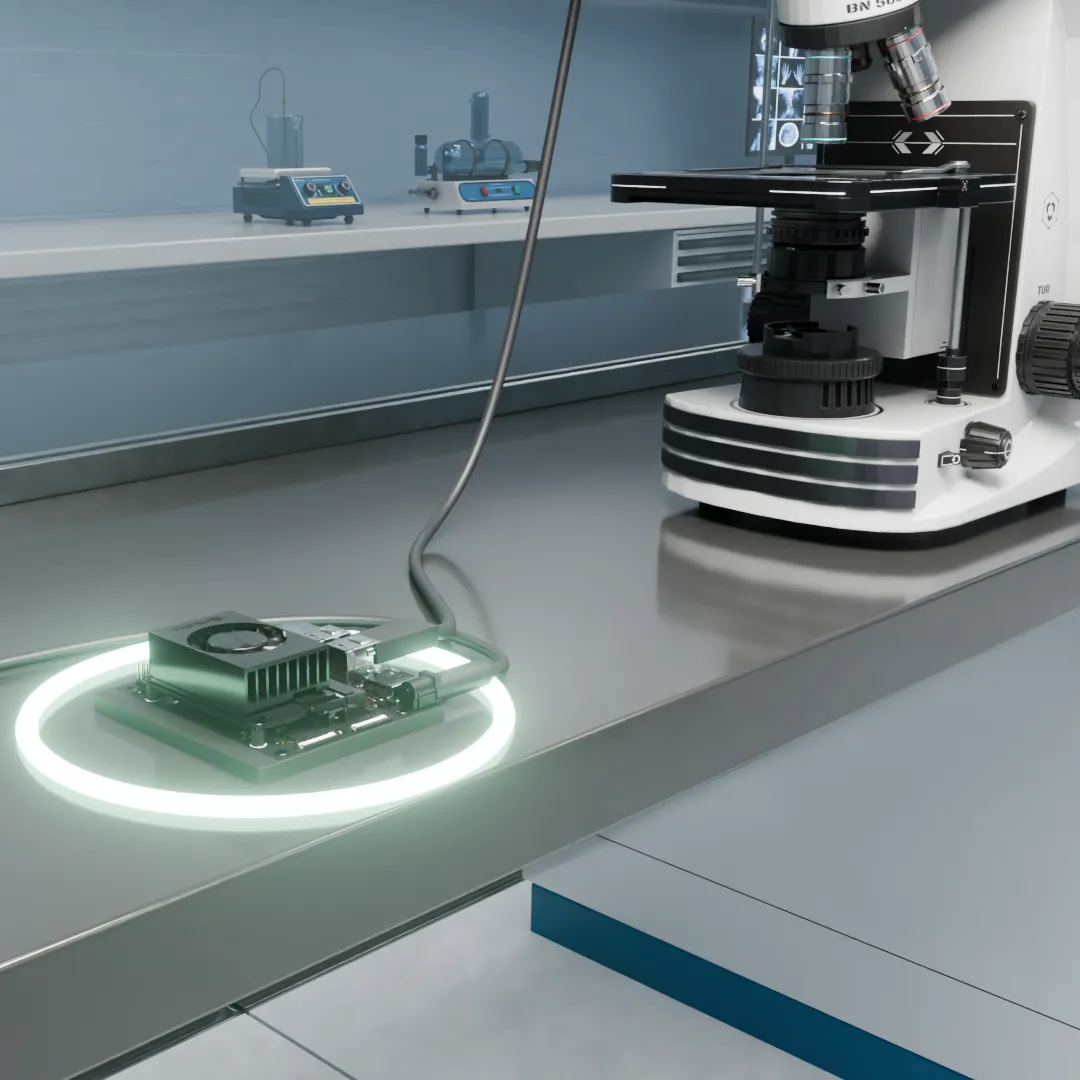
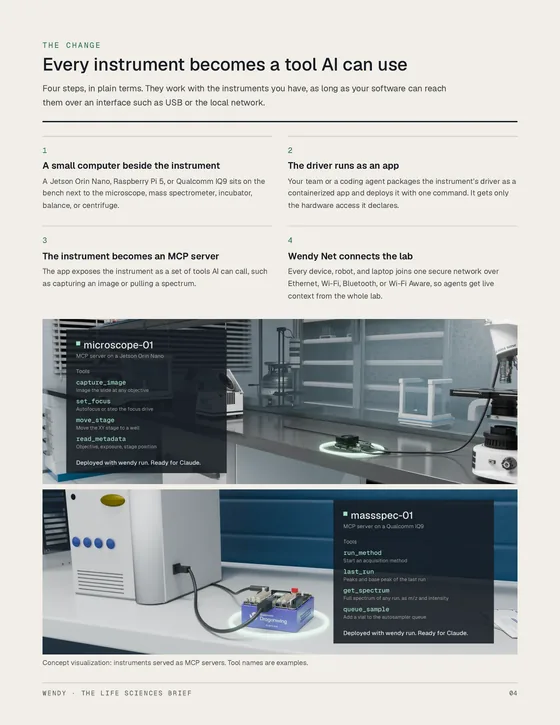
Concept visualization of a Jetson Orin Nano on a lab bench beside a research microscope, with its cable running to the camera port.Concept visualization
01

Instruments

Every instrument becomes a tool AI can use

  • A small computer beside each instrument

    Put a Jetson Orin Nano, Raspberry Pi 5, or Qualcomm IQ9 next to the microscope, mass spectrometer, incubator, balance, or centrifuge.

  • Drivers that deploy as apps

    Package an instrument’s driver as a containerized app in Python, Rust, Swift, C++, or TypeScript, and deploy it with one command: wendy run.

  • An MCP server for every instrument

    The app turns the instrument into an MCP server, a set of tools AI can call to capture an image, set focus, or pull a spectrum.

  • Only the hardware it declares

    Each app gets only the access it declares in wendy.json, such as USB, camera, GPIO, or networking.

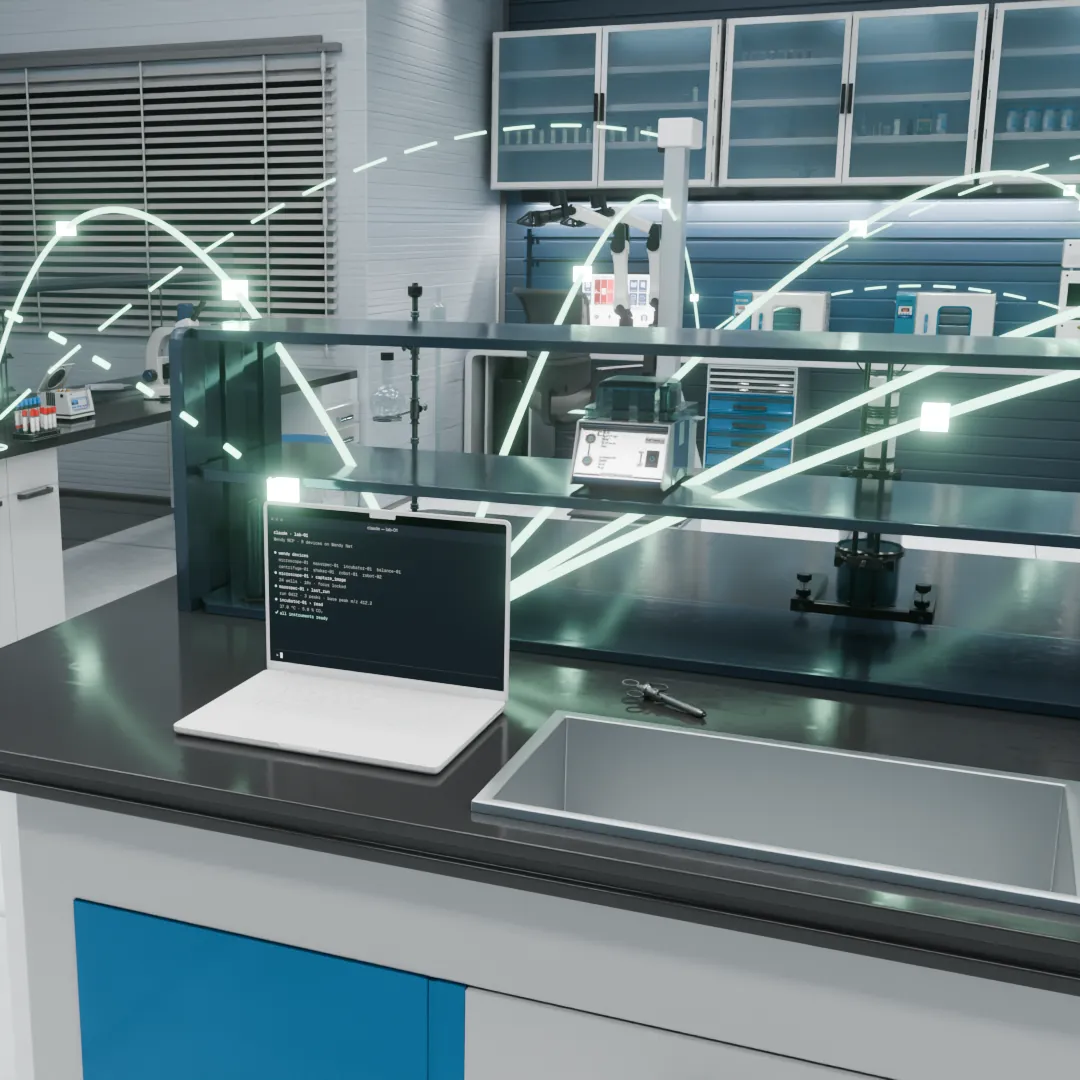
Concept visualization of a laptop running Claude on a lab island, under glowing network links from the instruments around the lab.Concept visualization
02

Network and agents

One secure network, with live context for AI

  • Wendy Net across the lab

    Wendy Net connects every device, robot, and laptop over Ethernet, Wi-Fi, Bluetooth, or Wi-Fi Aware, directly or through the devices in between.

  • Live context from every instrument

    AI agents like Claude read each instrument through MCP and can send each one its next step.

  • Robots running WendyOS

    Robots carry samples between stations, on the same network and platform as the instruments.

Concept visualization
03

The experiment loop

Design, run, measure, learn, day and night

  • Design

    Claude designs an experiment from live readings across the lab.

  • Run

    Robots and instruments run it.

  • Measure

    Every result streams straight back to the agent.

  • Learn

    It picks the next experiment, and the next one, around the clock.

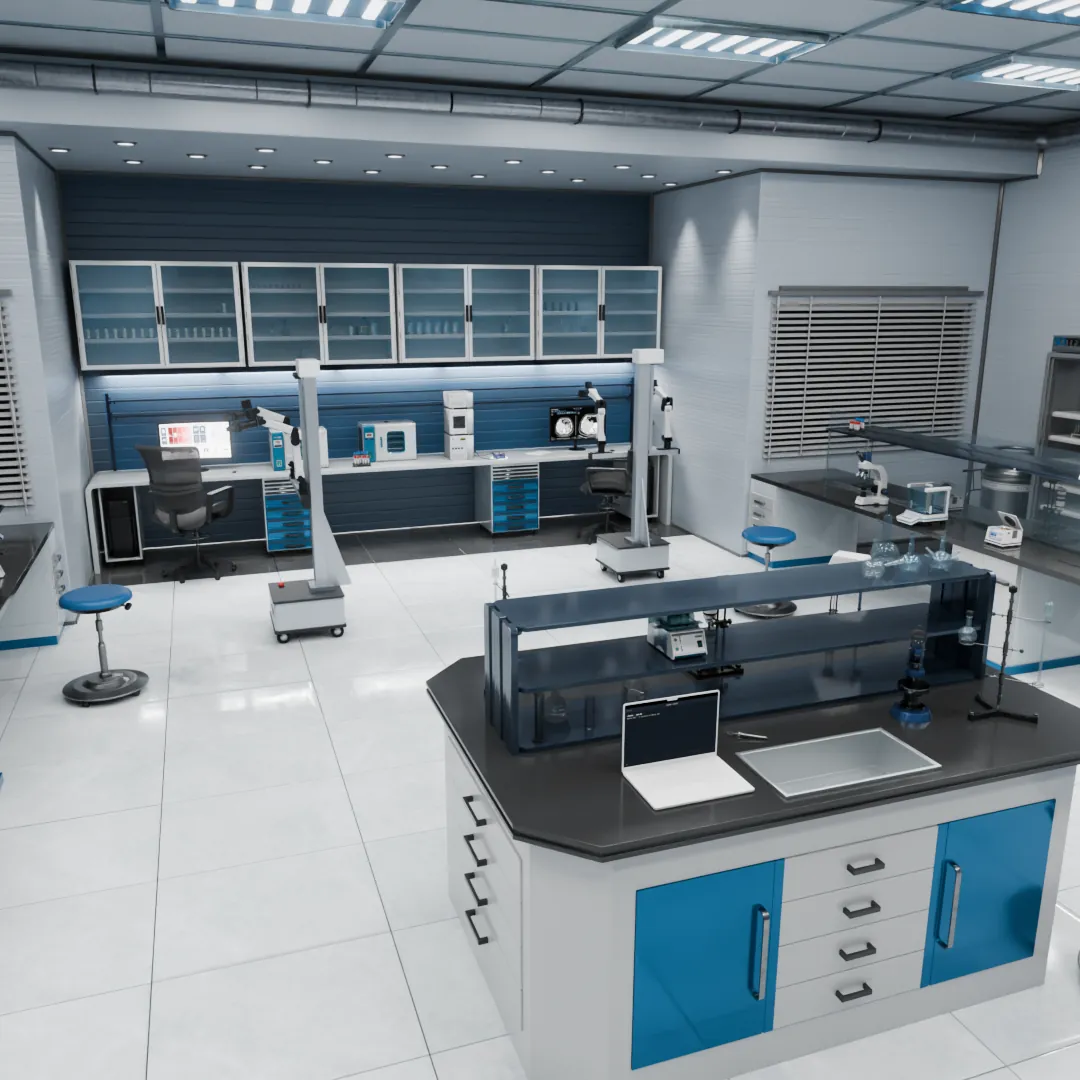
Concept visualization of a modern lab with a central island and instruments along the benches.Concept visualization
04

Your data, your lab

Repeatable, traceable, and on site

  • Runs fully offline

    Apps and on-device models run without internet, and you can deploy and update over USB-C or the local network.

  • Every connection authenticated

    Once a device is provisioned, every connection uses mutual TLS with per-device certificates.

  • Repeatable runs

    Containerized apps on a versioned OS image pin each run: same code, same stack, same device state.

  • Traceable by design

    Apps can log inputs, model versions, and decisions to an OpenTelemetry collector on the device, for your own traceability and audit process.

  • Open to inspection

    WendyOS, the CLI, and the agent are Apache 2.0 open source, and every release ships with an SBOM and build provenance.

The concept film

Speed up scientific discovery

A 1:28 concept film of how a lab could run on Wendy, from the first instrument to an experiment loop that runs day and night.

On real hardware

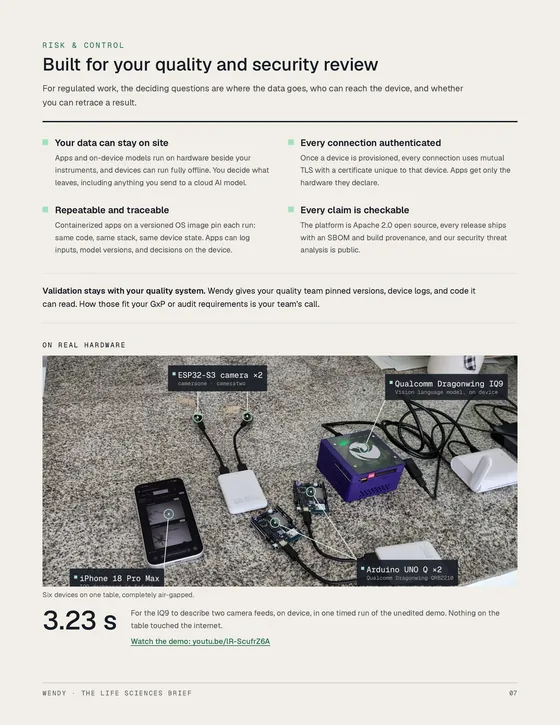
3.23 s

for a Qualcomm Dragonwing IQ9 to describe two camera feeds, on device, from one timed run of the unedited demo.

Six devices on one table, completely air-gapped. The IQ9 runs a vision language model, two ESP32-S3 cameras stream to it, two Arduino UNO Qs light up when someone walks in, and an iPhone asks it what it sees.

The life sciences brief

Take this to your team

Eight pages for lab and R&D leaders: what the disconnected lab costs, what changes with Wendy, how it holds up in a quality and security review, and a low-risk first step.

Get the brief

Common questions

Life Sciences FAQs

Direct answers about connecting lab instruments to AI, keeping data on site, and repeatable runs with WendyOS.

How does Wendy connect lab instruments to AI?

A small computer such as a Jetson Orin Nano, Raspberry Pi 5, or Qualcomm IQ9 sits beside each instrument and runs its driver as a containerized app. The app serves the instrument as an MCP server, and the Wendy MCP server passes those tools to AI agents such as Claude.

Which lab instruments can Wendy work with?

Instruments your software can talk to from a device beside them, over interfaces such as USB or the local network. Your team or a coding agent writes the driver as an app and deploys it with wendy run.

Can lab data stay on site?

Yes. Apps and on-device models run on the hardware beside your instruments, and Wendy devices can run fully offline, so instrument data does not have to leave the lab. You decide what leaves, including anything you send to a cloud AI model.

How does Wendy support repeatable runs and traceability?

Containerized apps on a versioned OS image keep code, stack, and device state the same from run to run. Apps can log inputs, model versions, and outputs to the OpenTelemetry collector on each device, and teams can use those records in their own traceability and audit processes.

Ask Wendy

Answers about Wendy and WendyOS

What would you like to know?

Ask about devices, development, and deployment.

Check linked docs for technical details.